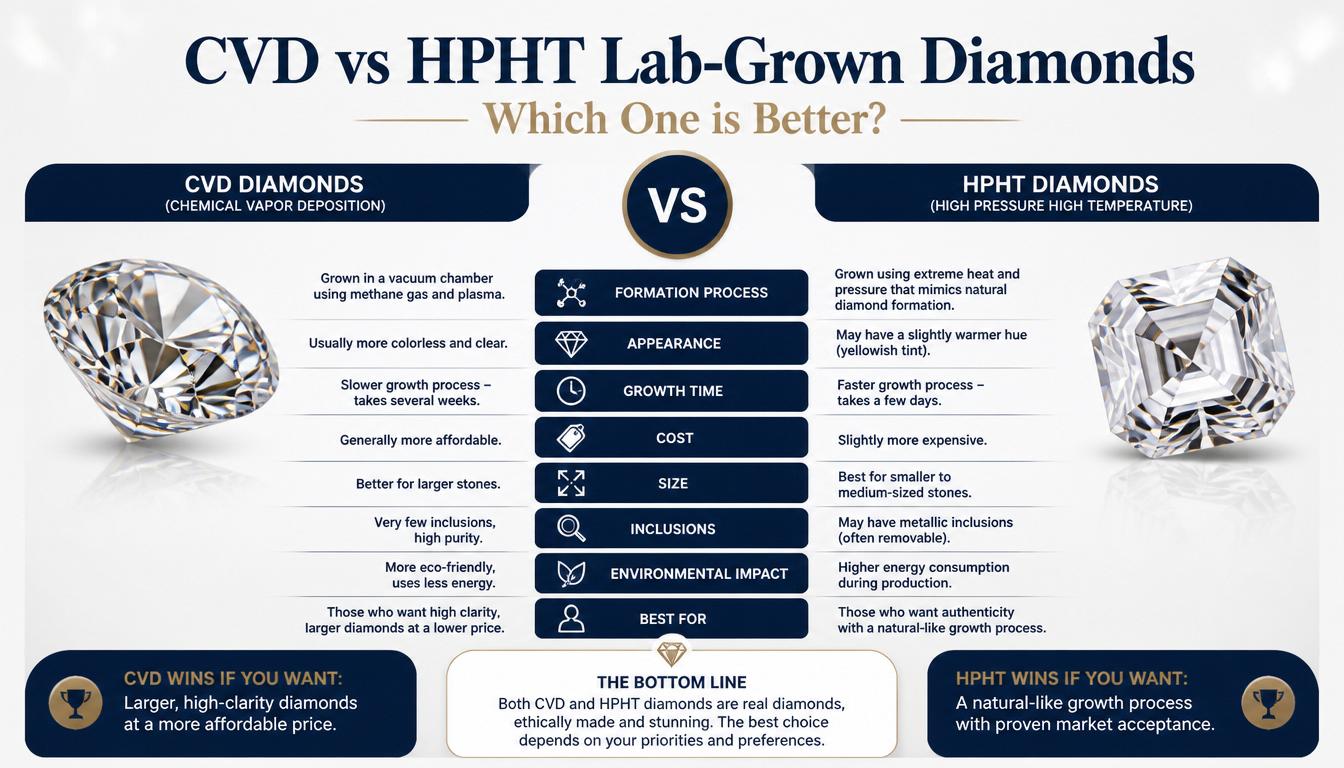
CVD vs HPHT Lab-Grown Diamonds: Which One is Better? - A Complete Guide
Key Takeaways
-
CVD vs HPHT lab-grown diamond comparison helps buyers understand two popular methods of creating real diamonds in laboratories.
-
CVD diamonds are created through Chemical Vapor Deposition technology, while HPHT diamonds use High Pressure High Temperature conditions.
-
Both CVD and HPHT diamonds have the same physical, chemical, and optical properties as mined diamonds.
-
HPHT diamonds often achieve excellent color quality, while CVD diamonds are popular for larger stones and modern jewelry designs.
-
The best choice depends on diamond quality, certification, budget, and personal preference.
CVD vs HPHT Lab-Grown Diamonds: Complete Guide
Lab-grown diamonds have transformed the jewelry industry by offering beautiful, ethical, and affordable alternatives to mined diamonds. Today, many buyers choosing engagement rings, earrings, and fine jewelry compare CVD vs HPHT lab-grown diamonds before making a purchase.
CVD diamonds and HPHT diamonds are actually diamonds that people make using really cool technology. The way they are made and where they are grown can be really different. So can the way they look when they are finished.
Knowing what is different about CVD diamonds and HPHT diamonds can help you pick the diamond based on how good it is, what it looks like, and how much it costs, which is important when you are choosing a CVD diamond or an HPHT diamond.
What Are CVD Diamonds?
CVD diamond meaning refers to Chemical Vapor Deposition diamonds, a modern process where diamonds are grown inside a controlled laboratory chamber.
During the CVD diamond process, a small diamond seed is placed inside a chamber filled with carbon-rich gases. These gases break down, allowing carbon atoms to attach layer by layer onto the diamond seed.
This process takes a while. It makes a really nice diamond that is grown in a lab. It has the same structure as a diamond that is found in nature, like a natural diamond. The lab-grown diamond is like a natural diamond.
Benefits of CVD Diamonds
-
Advanced diamond-growing technology
-
Suitable for high-quality jewelry
-
Often available in larger sizes
-
Excellent clarity potential
-
Environment-friendly choice
-
Popular for engagement rings
Because of advanced CVD diamond technology, many jewelers use CVD stones for modern lab-grown diamond jewelry.
Also Read
How to Buy an Engagement Ring: The Complete Guide to Choosing Your Forever Ring
What Are HPHT Diamonds?
HPHT diamond meaning stands for High Pressure High Temperature diamonds.
The HPHT diamond process recreates the natural conditions found deep inside the Earth where diamonds form.
A diamond seed is put under a lot of pressure, and it gets really hot so the carbon can come together. Form a diamond. The diamond seed is what starts it all, and the extreme pressure and high temperatures are what help the diamond grow into a diamond. The diamond seed and the process it goes through are what make the diamond what it's.
Benefits of HPHT Diamonds
-
Creates high-quality diamonds
-
Excellent color performance
-
Strong crystal structure
-
Similar growth environment to natural diamonds
-
Can produce premium color grades
HPHT technology was among the earliest successful methods for creating laboratory diamonds.
Difference Between CVD and HPHT Diamonds
When comparing CVD diamond vs HPHT diamond, the biggest difference is how they are created.
|
Feature |
CVD Diamonds |
HPHT Diamonds |
|
Full Name |
Chemical Vapor Deposition |
High Pressure High Temperature |
|
Growth Method |
Gas chamber technology |
Heat & pressure method |
|
Formation Style |
Carbon layers grow on a seed |
Mimics natural diamond formation |
|
Color Quality |
Very good |
Often excellent |
|
Size Availability |
Easier for larger diamonds |
Depends on growth process |
|
Appearance |
Diamond-like brilliance |
Diamond-like brilliance |
Both types of lab-grown diamonds can achieve excellent beauty and durability.
HPHT vs CVD Diamond Quality: Which is Better?
When discussing HPHT vs CVD diamond quality, one method is not automatically better than the other.
The final diamond quality depends on:
-
Cut
-
Color
-
Clarity
-
Carat weight
-
Certification
-
Manufacturing quality
A good CVD diamond can be better than an HPHT diamond. On the other hand, a top-notch HPHT diamond can be better than a low-grade CVD diamond. You should always check diamond grading reports from labs.
How Are Lab-Grown Diamonds Made?
Many buyers ask, how are lab-grown diamonds made?
Lab-grown diamonds are created by placing a diamond seed in a controlled environment where carbon atoms grow into a complete diamond.
The two main types of lab-grown diamonds are:
-
CVD Diamonds
-
HPHT Diamonds
Both methods produce genuine diamonds that can be used in rings, bracelets, necklaces, and other fine jewelry.
Which is Better: CVD or HPHT Diamond?
Choosing between CVD vs HPHT lab-grown diamonds depends on what you value most.
Choose CVD diamonds if you prefer:
-
Modern technology
-
Larger diamond options
-
Great value
-
Beautiful everyday jewelry
Choose HPHT diamonds if you prefer:
-
Excellent color grades
-
Traditional diamond growth simulation
-
Premium-quality options
For most buyers, certification and the 4Cs matter more than whether the diamond is CVD or HPHT.
Are Lab-Grown Diamonds Worth Buying?
Yes, lab-grown diamonds are becoming extremely popular because they provide:
-
Luxury appearance
-
Ethical sourcing
-
Better affordability
-
Beautiful sparkle
-
Modern technology
They offer the same brilliance and durability expected from diamond jewelry.
Conclusion: CVD vs HPHT Lab-Grown Diamonds
When comparing CVD vs HPHT lab-grown diamonds, both options are excellent choices. CVD diamonds use advanced Chemical Vapor Deposition technology, while HPHT diamonds use High Pressure High Temperature conditions.
When it comes to CVD diamond and HPHT diamonds, you will not find a winner. The reason is that the quality of CVD diamond and HPHT diamonds really depends on the characteristics of each stone.
When you are choosing between CVD diamond and HPHT diamonds, what you should really think about is the certification of the CVD diamond and HPHT diamonds. You should also consider the quality of the cut of the CVD diamond and HPHT diamonds. How they look overall.
FAQs About CVD vs HPHT Lab-Grown Diamonds
1. What is the difference between CVD and HPHT diamonds?
The main difference between CVD and HPHT diamonds is the creation process. CVD diamonds grow using Chemical Vapor Deposition technology, while HPHT diamonds form through High Pressure High Temperature conditions.
2. Is CVD diamond better than HPHT?
CVD diamonds are not always better than HPHT diamonds. Both methods can create high-quality lab-grown diamonds depending on cut, clarity, color, and manufacturing standards.
3. Which lab-grown diamond method is best?
Both CVD and HPHT methods are excellent. The best lab-grown diamond method depends on the desired quality, budget, and diamond specifications.
4. Are CVD diamonds real diamonds?
Yes, CVD diamonds are real diamonds. They have the same chemical composition, hardness, and sparkle as mined diamonds.
5. Do HPHT diamonds look natural?
Yes, HPHT diamonds look natural because they have the same crystal structure and appearance as natural diamonds.
6. Are CVD diamonds cheaper than HPHT?
Sometimes CVD diamonds can be more affordable because the production process can be efficient, but price mainly depends on size and quality.
7. How long do lab-grown diamonds last?
Lab-grown diamonds can last forever with proper care because they have the same durability and hardness as natural diamonds.
8. Can experts identify CVD and HPHT diamonds?
Yes, trained experts using advanced equipment can determine whether a diamond was created by CVD or HPHT.

Written by Shikhar Jain