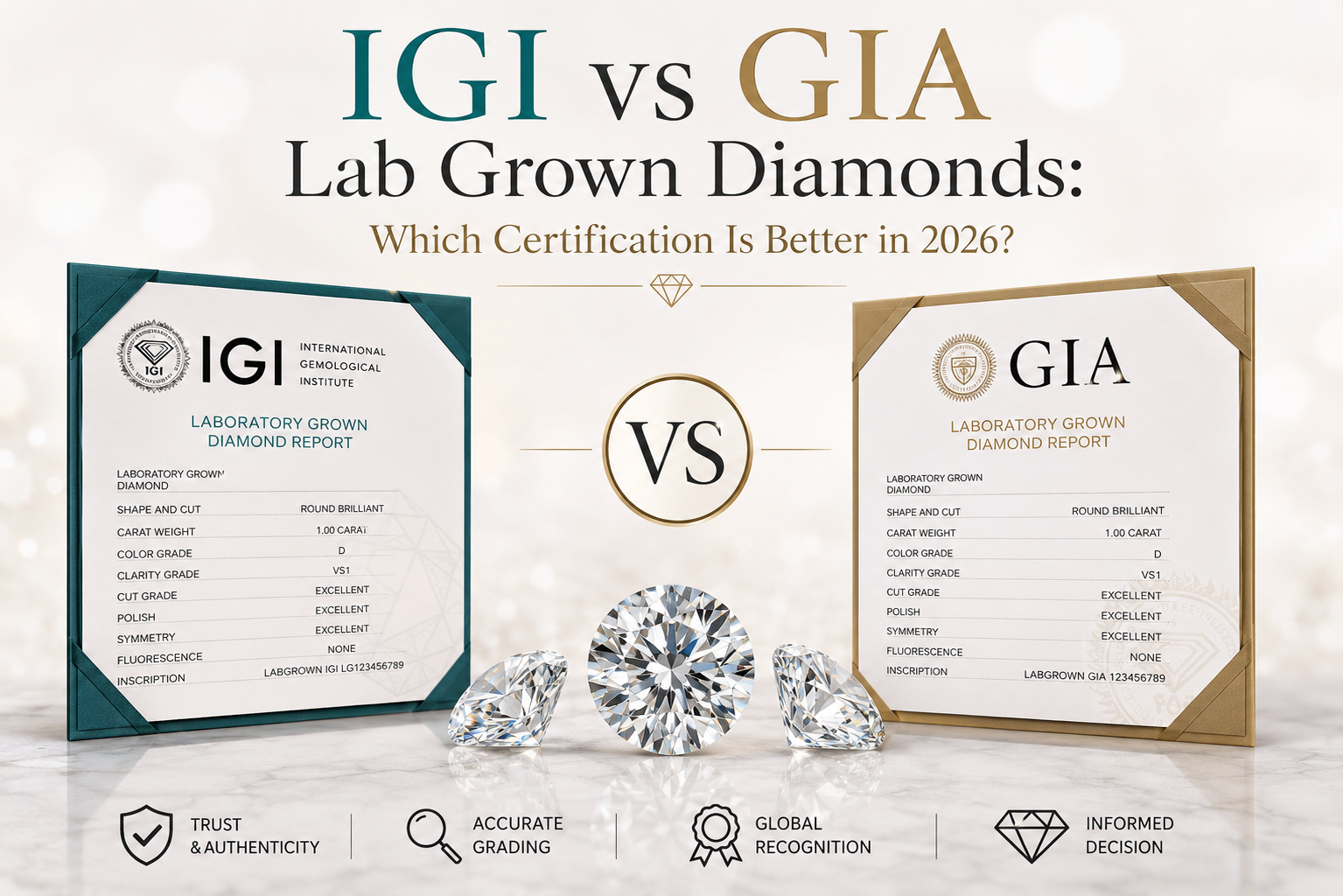
IGI vs GIA Lab Grown Diamonds: Which Certification Is Better in 2026?
Key Takeaways
-
Choose trusted certification: Always buy lab-grown engagement rings with IGI or GIA certification to ensure accurate and independent diamond grading.
-
Focus on the 4Cs: Compare Cut, Color, Clarity, and Carat Weight to find the best balance between beauty, quality, and budget.
-
Verify the grading report: Check the certificate number on the official IGI or GIA website and match it with the laser inscription on the diamond whenever possible.
-
Buy from a reputable jeweler: Purchase from trusted retailers that provide transparent pricing, detailed product information, warranties, and hassle-free return policies.
-
Prioritize quality over size: An Excellent or Ideal Cut diamond often appears more brilliant than a larger diamond with lower cut quality, making it a smarter long-term investment.
Introduction on IGI vs GIA Lab Grown Diamonds
IGI vs GIA Lab Grown Diamonds: Buying a lab-grown diamond engagement ring is a good idea for couples these days. Lab-grown diamonds are just as beautiful and strong as diamonds, but they cost a lot less. The thing is, the value of a lab-grown diamond really depends on whether it has been certified or not.
If you get a report from a lab that is known for being honest, you can be sure that your diamond is good quality. Without this report, you have no way of knowing if you are paying a price or if the diamond is any good.
In this guide, we will tell you what the certifications from GIA and IGI mean. You will also learn how to understand the report that comes with your diamond and how to pick the certified lab-grown diamond for your engagement ring in 2026. Lab-grown diamonds are a choice, and with the right certification, you can be sure you are making a good decision when you buy a lab-grown diamond engagement ring.
Why Diamond Certification Matters
When you buy a diamond, you get a diamond certificate. This is also called a grading report. It is like a review of the diamond. People who know a lot about gems, called gemologists, write this report. They look at the diamond. Write down what they find. This way you do not just have to take the seller's word for it. You get to see a report from the gemologists. The diamond certificate tells you all about the diamond.
A certified grading report helps you:
-
Verify that your diamond is lab-grown.
-
Confirm the 4Cs (Cut, Color, Clarity, and Carat Weight).
-
Compare diamonds from different retailers.
-
Understand the true market value.
-
Buy with greater confidence.
-
Simplify insurance and resale documentation.
Whether you purchase online or from a local jeweler, certification provides transparency and protects your investment.
What Is GIA?
The Gemological Institute of America is one of the respected places that looks at gems. The Gemological Institute of America was started in 1931. The Gemological Institute of America made a way to grade diamonds that everyone uses. This way is called the 4Cs. The Gemological Institute of America uses the 4Cs to grade diamonds that are made in a lab too. The Gemological Institute of America has high standards for grading these lab-grown diamonds.

Why Buyers Trust GIA
-
Globally recognized authority
-
Extremely consistent grading standards
-
Independent and unbiased reports
-
Highly respected in international markets
-
Excellent reputation for accuracy
A GIA report typically includes:
-
Diamond shape
-
Measurements
-
Carat weight
-
Color grade
-
Clarity grade
-
Cut grade (for round diamonds)
-
Polish
-
Symmetry
-
Fluorescence
-
Growth method (CVD or HPHT)
-
Laser inscription (when available)
Many buyers choose GIA because of its long-standing reputation and conservative grading practices.
What Is IGI?
The International Gemological Institute is a big deal when it comes to checking the quality of lab-grown diamonds all over the world. Lots of jewelry companies that sell lab-created diamonds love working with the International Gemological Institute. Many big online stores sell diamonds that have been checked by the International Gemological Institute because they are easy to get, and the International Gemological Institute gives detailed reports about the diamonds.

Benefits of IGI Certification
-
Widely accepted around the world
-
Excellent specialization in lab-grown diamonds
-
Faster grading turnaround
-
Detailed grading reports
-
Easy online certificate verification
-
Large database of certified diamonds
IGI reports generally include:
-
Carat weight
-
Color grade
-
Clarity grade
-
Cut grade
-
Polish
-
Symmetry
-
Fluorescence
-
Growth process
-
Diamond proportions
-
Laser inscription details
IGI remains one of the most common certifications for lab-grown engagement rings in 2026.
Also Read
Lab-Grown Diamond Jewelry: A Complete Everyday-Wear Guide
IGI vs GIA Lab Grown Diamonds: Which Certification Is Better?
Choosing between IGI and GIA depends on your priorities.
|
Feature |
IGI |
GIA |
|
Popular for Lab Grown Diamonds |
Excellent |
Excellent |
|
International Recognition |
High |
Very High |
|
Report Detail |
Excellent |
Excellent |
|
Consumer Trust |
High |
Extremely High |
|
Availability |
Very Common |
Growing |
|
Premium Reputation |
High |
Highest |
For most buyers, both certifications provide excellent protection. Purchasing from a trusted jeweler is often just as important as choosing the grading laboratory.
How to Choose a Certified Lab-Grown Diamond
Choosing a certified diamond involves more than selecting the highest carat weight.
1. Always Buy a Certified Diamond
Avoid buying diamonds without a grading report. A certification report makes sure the quality claims are checked by a lab that is not connected to the seller.
2. Understand the 4Cs
Cut
Cut has the greatest impact on brilliance.
Look for:
-
Excellent Cut
-
Ideal Cut
-
Very Good Cut
Color
Lab-grown diamonds are graded from D to Z.
Recommended range:
-
D–F: Colorless
-
G–H: Near Colorless
-
I–J: Slight warmth but still attractive
Clarity
Most inclusions cannot be seen without magnification.
Popular choices include:
-
VVS1
-
VVS2
-
VS1
-
VS2
These grades often provide the best balance between beauty and value.
Carat Weight
Choose a carat size that matches your budget rather than sacrificing quality.
Popular engagement ring sizes:
-
1.00 Carat
-
1.50 Carat
-
2.00 Carat
-
3.00 Carat
3. Verify the Certificate Online
Always verify the report number on the grading laboratory's official website before purchasing.
This confirms that:
-
The report is authentic.
-
The grading matches the seller's description.
-
The diamond has not been misrepresented.
4. Compare Multiple Diamonds
Never purchase the first diamond you see.
Compare:
-
Certification
-
Price
-
Cut
-
Clarity
-
Color
-
Carat
-
Measurements
Even diamonds with similar grades may differ significantly in appearance.
5. Choose a Trusted Jeweler
Buy from retailers who:
-
Provide high-resolution images
-
Offer videos
-
Display grading reports
-
Have transparent return policies
-
Explain certification clearly
A reputable jeweler makes the buying process much easier.
How to Read a Lab-Grown Diamond Grading Report
Understanding your grading report helps you make a smarter purchase.
Report Number
Every certified diamond gets its special number that is just for that diamond. A lot of diamonds also have a small inscription that is made with a laser, and it has the same number as the certified diamond.
Shape
Examples include:
-
Round Brilliant
-
Oval
-
Cushion
-
Emerald
-
Pear
-
Princess
-
Marquise
-
Radiant
Measurements
The size of the diamond is really important. Measurements tell us how big the diamond is. This affects how shiny the diamond looks and what it looks like overall. The diamond measurements are what describe the dimensions of the diamond. The measurements of the diamond influence the brilliance of the diamond and the overall appearance of the diamond.
Carat Weight
The carat of a diamond measures how much it weighs, not how big it is. You can have two diamonds that have the same carat weight, but they do not look the same because of their different shapes and proportions. The carat is really about the weight of the diamond, so two diamonds with the same carat weight can look different when you see them.
Color Grade
Colorless diamonds receive higher grades.
Grades range from:
-
D (highest)
-
through
-
Z (noticeable yellow or brown tint)
Clarity Grade
Clarity measures internal inclusions and external blemishes.
Common grades:
-
FL
-
IF
-
VVS1
-
VVS2
-
VS1
-
VS2
-
SI1
-
SI2
Cut Grade
Round diamonds usually receive:
-
Excellent
-
Very Good
-
Good
-
Fair
-
Poor
Excellent cut diamonds reflect the most light.
Polish
The polish of a diamond is how smooth the surface is. When a diamond has a polish, it does a better job of dealing with light. The polish of the diamond really matters because it helps the diamond look its best. A diamond with a polish will perform better with light.
Symmetry
The symmetry of a diamond is how well the facets of the diamond line up. When the diamond has symmetry, the sparkle of the diamond is really improved. The symmetry of the diamond is very important because it affects how much the diamond sparkles. Excellent symmetry makes the diamond sparkle more.
Fluorescence
Some diamonds glow when you shine light on them. Most buyers like diamonds with no fluorescence or just a little bit.
Growth Method
Lab-grown diamonds are produced using:
-
CVD (Chemical Vapor Deposition)
-
HPHT (High Pressure High Temperature)
Both methods produce real diamonds.
Comments Section
Additional information may include:
-
Laser inscription
-
Post-growth treatment
-
Identification notes
Always review this section carefully.
Common Mistakes to Avoid
Many buyers make these mistakes:
-
Buying an uncertified diamond
-
Ignoring cut quality
-
Choosing only based on carat size
-
Not verifying the certificate
-
Comparing diamonds from different grading standards without understanding the differences
-
Buying from unreliable sellers
Avoiding these mistakes can save both money and disappointment.
Why Choose Star Joya for Certified Lab Grown Diamonds?
At Star Joya, we think every engagement ring should show trust, quality, and great craftsmanship. That's why our lab-grown diamond engagement rings have carefully picked diamonds with trusted certifications from gem labs, like IGI and GIA when they are available.
Each diamond is chosen for its good cut and great value so you get a ring that is really top quality. If you want a solitaire, a vintage-style ring, or a custom engagement ring, Star Joya has lovely jewelry made from great materials and lab-grown diamonds that are sourced ethically.
We have prices, safe shopping, great customer service, and certified diamonds you can trust. Star Joya makes it easy to celebrate moments in life with confidence, and that is what we do.
Final Thoughts on IGI vs GIA Lab Grown Diamonds
When you are looking for a lab-grown engagement ring, certification is really important. You need to think about what kind of certification you want. Do you want a GIA certification or an IGI certification? Either way, getting a diamond is a good idea. It helps you know that the diamond is real and that you are getting what you pay for.
For people buying lab-grown engagement rings in 2026, IGI certification is a choice. IGI-certified lab-grown diamonds are a mix of quality and price. You get a lot of options. You can find something that fits your budget. Some people still like to get a GIA certification because it is well known all over the world.
Before you buy a lab-grown engagement ring, do some research. Look at a lot of certified diamonds and compare them. Make sure you understand what the grading report means. You can even check the certificate online to make sure it is real. Only buy from a jeweler that you trust. If you follow these steps, you can find a lab-grown engagement ring that you will love and that fits your budget. Lab-grown engagement rings are an option, and certification is a big part of that. Lab-grown engagement rings, with certification, are the way to go.
Frequently Asked Questions (FAQs) About IGI vs GIA Lab Grown Diamonds
1. Which certification is best for lab-grown engagement rings?
Both GIA and IGI are trusted certification laboratories. GIA is known for its strict grading standards, while IGI is widely recognized for grading a large number of lab-grown diamonds and offering excellent value.
2. Is an IGI-certified lab-grown diamond worth buying?
Yes. IGI-certified lab-grown diamonds are widely accepted, accurately graded, and trusted by many leading jewelry retailers worldwide.
3. How can I verify a lab-grown diamond certificate?
Visit the official grading laboratory's website and enter the certificate or report number. You can confirm the diamond's grading details and verify the authenticity of the report.
4. What should I check first on a lab-grown diamond grading report?
Start by reviewing the report number, 4Cs (Cut, Color, Clarity, and Carat Weight), growth method (CVD or HPHT), measurements, and any comments or laser inscription details.
5. Does certification increase the value of a lab-grown diamond?
Certification doesn't increase the intrinsic value of the diamond, but it provides verified proof of quality, making it easier to compare diamonds, insure your purchase, and buy with confidence.

Written by Shikhar Jain