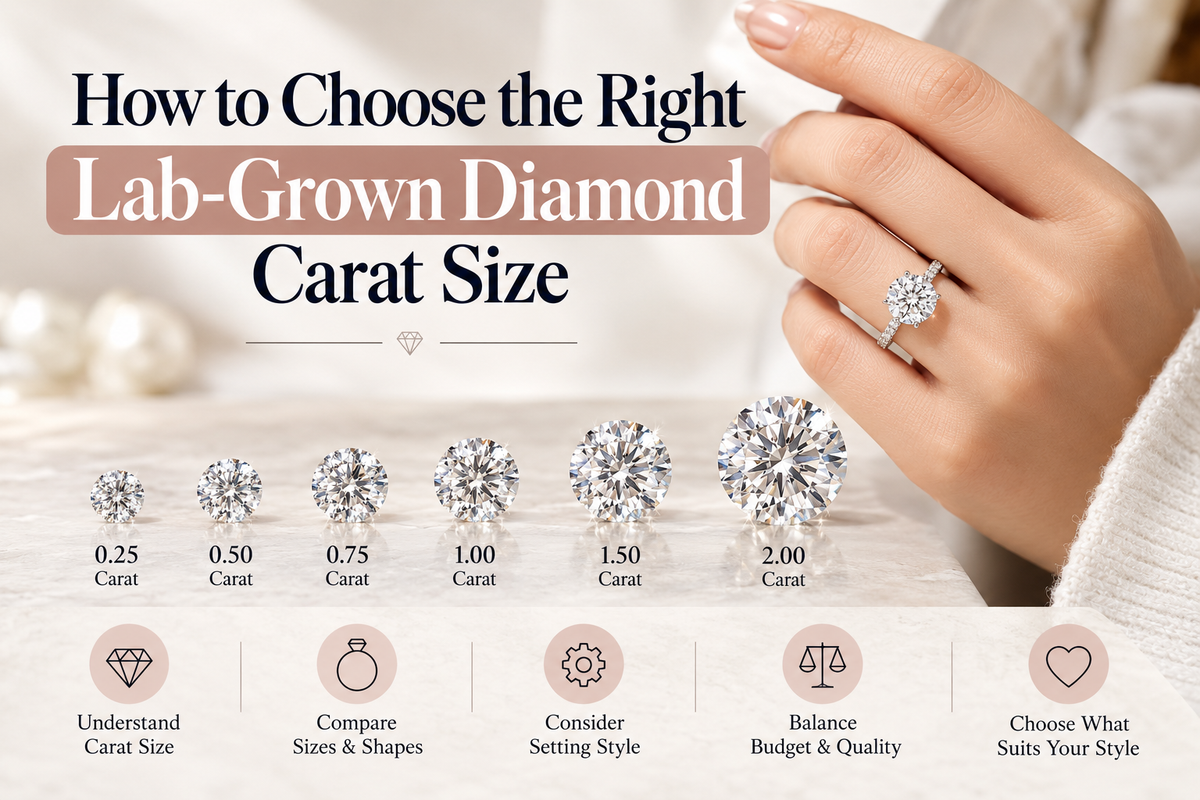
How to Choose the Right Lab-Grown Diamond Carat Size
Choosing a diamond is not about picking the largest stone you can afford. The carat size plays a role in how the diamond looks. It affects the presence, the proportions, what kind of setting it can fit into, and the overall style. With lab-grown diamonds now available in different sizes, people have more choices. This makes it easier to find a diamond that matches their taste, fits the occasion, and stays within budget.
Understanding Lab-Grown Diamond Carat Size can make the buying process much easier. Whether you are shopping for an engagement ring, anniversary gift, pendant, earrings, or an everyday piece of jewelry, knowing how carat weight works will help you make a more informed choice.
In this guide, we talk about what carat size means. We show how different carat weights look in real life. We also cover what to think about when picking a size. We explain how to balance carat weight with cut, shape, and setting.
Key Takeaways
-
Carat refers to diamond weight, not directly to its visible size.
-
Two diamonds with the same carat weight can have different visual appearances.
-
Diamond shape can significantly affect perceived size.
-
Oval, pear, and marquise shapes can create an elongated face-up appearance.
-
A halo setting can increase the overall visual footprint of a ring.
-
Cut quality plays an important role in a diamond's brilliance.
-
Consider carat alongside color, clarity, cut, measurements, and certification.
-
The ideal carat size depends on personal style, jewelry type, and budget.
-
For earrings, remember that total carat weight may be divided between two stones.
-
Choosing the right Lab-Grown Diamond Carat Size is ultimately about finding the right balance between appearance, design, and personal preference.
What Is Lab-Grown Diamond Carat Size?
Each carat of a diamond is a measure of its weight, not its size. One carat equals 200 milligrams, which's the same as 0.2 grams. A 2‑carat diamond will weigh as much as a 1‑carat diamond. However, two diamonds with the same carat weight can look different from one another. Their visible size depends on factors such as:
-
Diamond shape
-
Cut proportions
-
Depth and table measurements
-
Setting style
-
Diamond dimensions
-
How efficiently the diamond distributes its weight
For example, a well-cut round diamond and an elongated oval diamond can have the same carat weight but create noticeably different visual effects. This is why carat weight should be considered alongside the diamond's cut, color, clarity, and shape.
Also Read: How to Buy a Lab-Grown Diamond Engagement Ring Online - A Guide By Star Joya
Understanding Common Lab-Grown Diamond Carat Sizes
There is no perfect carat size. Different sizes give different looks, and the best choice depends on what you personally like. Some people prefer something more subtle while others want a bigger stone that stands out. It all comes down to your style, how you plan to wear it, and what feels right for you.
0.25–0.50 Carat
Smaller diamonds can create a delicate and understated appearance. These sizes work particularly well for:
-
Minimalist rings
-
Petite engagement rings
-
Stackable rings
-
Earrings
-
Pendants
A 0.50-carat diamond can offer noticeable sparkle while maintaining a refined appearance.
0.75–1.00 Carat
Around the one-carat range is a choice for engagement rings and everyday jewelry. It offers a balance between presence and practicality.
A 1-carat diamond can work beautifully in:
-
Solitaire rings
-
Halo settings
-
Three-stone rings
-
Pendant necklaces
-
Stud earrings
If you want a classic diamond appearance without an oversized look, this range can be worth considering.
1.25–1.50 Carat
Moving beyond one carat creates a visual presence. A one point two five- or one point five carat diamond can make a statement while still keeping a classic look.
These sizes are especially attractive for engagement rings and statement jewelry.
2.00 Carat and Above
Diamonds that weigh 2 carats or more have a visual impact. They are often chosen for engagement rings, anniversary jewelry, and special‑occasion pieces. At larger carat weights, cut quality becomes especially important because proportions and symmetry can significantly influence how the diamond looks.
Carat Weight vs. Visible Diamond Size
One of the most important things to understand about Lab-Grown Diamond Carat Size is that carat weight does not tell you exactly how large a diamond will appear. Consider two diamonds that weigh the same. One might have more of its weight placed toward the bottom, while the other might have shapes that make it look bigger when viewed from the top. The millimeter measurements—length, width, and depth—can therefore be useful when comparing diamonds. For shoppers who want a larger-looking diamond without necessarily increasing carat weight significantly, elongated shapes such as oval, pear, marquise, and emerald can create a distinctive face-up appearance.
How Diamond Shape Affects Carat Appearance
Diamond shape has a major influence on perceived size.
Round
Round brilliant diamonds are famous for their sparkle and timeless look. They stand out for their beauty and are often chosen for engagement rings and simple solitaire designs.
Oval
Oval diamonds have an oval shape. Oval diamonds can look larger across the finger than a diamond that weighs the same. Oval diamonds spread more across the finger than a diamond of equal weight.
Emerald
Emerald-cut diamonds are step-cut. Cut diamonds emphasize clarity and symmetry. Cut diamonds look sophisticated, not bright, with intense sparkle.
Pear
Pear-shaped diamonds blend features of round and marquise cuts. Their long teardrop shape gives a unique appearance.
Marquise
The long, narrow shape of a marquise diamond can create finger coverage when compared to its carat weight.
Cushion
Cushion-cut diamonds have rounded corners and a softer, romantic appearance. They can work particularly well in vintage-inspired and halo settings.
Choosing the Right Carat Size for an Engagement Ring
When you choose an engagement ring, think about how the diamond will show on the wearer’s hand. Finger size, ring design, and setting all change how the engagement ring looks. A 1‑carat diamond can look very different when the diamond sits in a solitaire setting versus a halo setting.
Think about the overall style you want:
For a minimalist look:
Consider a smaller center stone in a solitaire or delicate setting.
For a classic look:
A round brilliant diamond around the 0.75–1.50-carat range can create a timeless appearance.
For maximum visual presence:
Consider a larger center stone or an elongated diamond shape.
For additional sparkle:
A halo setting can visually enhance the center diamond by surrounding it with smaller stones.
The key is to choose a carat size that complements the ring design rather than selecting weight alone.
How Setting Style Changes Perceived Carat Size
The setting can make a significant difference in how large a diamond appears.
Solitaire Setting
A solitaire puts the focus on the center stone. Even a small diamond can look very prominent when there are no other stones around to compete for attention.
Halo Setting
A halo surrounds the center diamond with smaller diamonds. This can increase the overall visual footprint of the ring.
Three-Stone Setting
Three-stone rings are made with a center diamond and two side stones. The total diamond coverage can make the ring look more substantial. Three-stone rings can give a substantial look because of the diamond coverage.
Bezel Setting
A bezel setting surrounds the diamond with metal. The bezel setting gives the diamond a contemporary appearance and offers extra protection around the diamond. I appreciate how the metal keeps the diamond safely in place.
Carat Size and Budget
Lab-grown diamonds can provide shoppers with additional flexibility when considering carat weight and overall budget. Instead of thinking about how heavy the diamond is, think about how you want to use your money across the four main factors: cut, color, clarity, and carat.
For example, you may prefer a slightly smaller diamond with an excellent cut rather than a larger diamond with compromises in cut quality.
A well‑cut diamond reflects light well and gives a sparkle, so the cut is a key factor when comparing different Lab‑Grown Diamond Carat Size options.
Should You Choose a Larger or Smaller Diamond?
The answer depends on your priorities.
Choose a larger carat size if:
-
You prefer a bold statement
-
You want greater visual presence
-
The jewelry design is intended for special occasions
-
Finger coverage is important to you
Consider a smaller carat size if:
-
You prefer minimalist jewelry
-
You want an understated everyday look
-
You are prioritizing cut or other diamond characteristics
-
You prefer delicate settings
There is no universal ideal carat size. The best choice is the one that fits the wearer's style and the purpose of the jewelry.
Consider the Jewelry Type
The ideal Lab-Grown Diamond Carat Size can also vary depending on the type of jewelry.
Rings
Center stones in engagement and statement rings generally use larger carat weights than individual accent stones.
Earrings
For diamond earrings, carat weight may be divided between two stones. For example, a pair with a total carat weight of 1.00 carat could consist of approximately 0.50 carat per earring.
Necklaces
Pendant necklaces can use a single center stone, making the carat weight an important part of the design's visual focus.
Bracelets
Tennis bracelets typically contain many smaller diamonds distributed across the bracelet, so total carat weight can be more important than the size of an individual stone.
Don't Forget Diamond Cut Quality
Carat weight should never be looked at alone. A diamond that has proportions and symmetry can look brighter because it works well with light. Diamonds that are not shaped right might seem dull even if they are bigger in size.
When comparing diamonds, look at:
-
Cut quality
-
Polish
-
Symmetry
-
Measurements
-
Shape
-
Color
-
Clarity
-
Certification
This broader evaluation can help you choose a diamond that delivers the appearance you want.
Lab-Grown Diamonds Offer More Choice
Lab-grown diamonds are the same as natural diamonds when it comes to their chemical makeup and how their crystals are arranged. They are made with high-tech methods of being formed deep under the ground over millions of years. Because lab-grown diamonds are available in various carat weights, shapes, and specifications, shoppers can explore different combinations to find a design that matches their preferences. From a half-carat ring to a dramatic 2-carat statement piece, many options exist when picking the right Lab-Grown Diamond Carat Size. Lab-Grown Diamond Carat Size offers choices.
Final Thoughts On Lab-Grown Diamond Carat Size
Choosing the right Lab-Grown Diamond Carat Size doesn't have to be complicated. Start by thinking about the type of jewelry, your preferred style, the desired visual presence, and your budget. Then compare carat weight with the diamond's shape, measurements, cut, color, clarity, and certification. Whether you like a diamond for everyday elegance or a large center stone for a bold engagement ring, knowing carat weight helps you shop with more confidence. The right diamond isn't simply the one with the carat weight; it is the one whose size, shape, quality, and design fit together to create the look you want.
Frequently Asked Questions About Lab-Grown Diamond Carat Size
1. What is the best Lab-Grown Diamond Carat Size for an engagement ring?
There is no universally ideal carat size. Many shoppers consider sizes around 0.75 to 1.50 carats for engagement rings, while others prefer smaller or larger stones. The best choice depends on personal style, ring design, finger coverage, and budget.
2. Does a higher carat mean a bigger-looking diamond?
Not necessarily. Carat measures weight, while visible size depends on the diamond's dimensions, shape, cut proportions, and depth. Two diamonds with the same carat weight can therefore have different face-up appearances.
3. Which diamond shape looks the largest for its carat weight?
Elongated shapes such as oval, pear, and marquise can create a larger-looking face-up appearance relative to their carat weight. Actual appearance depends on the individual diamond's proportions and measurements.
4. Is a 1-carat lab-grown diamond a good size for everyday jewelry?
A 1-carat lab-grown diamond can work well for everyday jewelry, especially engagement rings, pendants, and earrings. The appropriate size ultimately depends on the design and the wearer's preferred level of visual presence.
5. Should I prioritize carat size or diamond cut?
Both matter, but they serve different purposes. Carat affects weight and potential visual presence, while cut influences how effectively the diamond interacts with light. Comparing both factors can help you find a balance that matches your preferences.

Written by Shikhar Jain