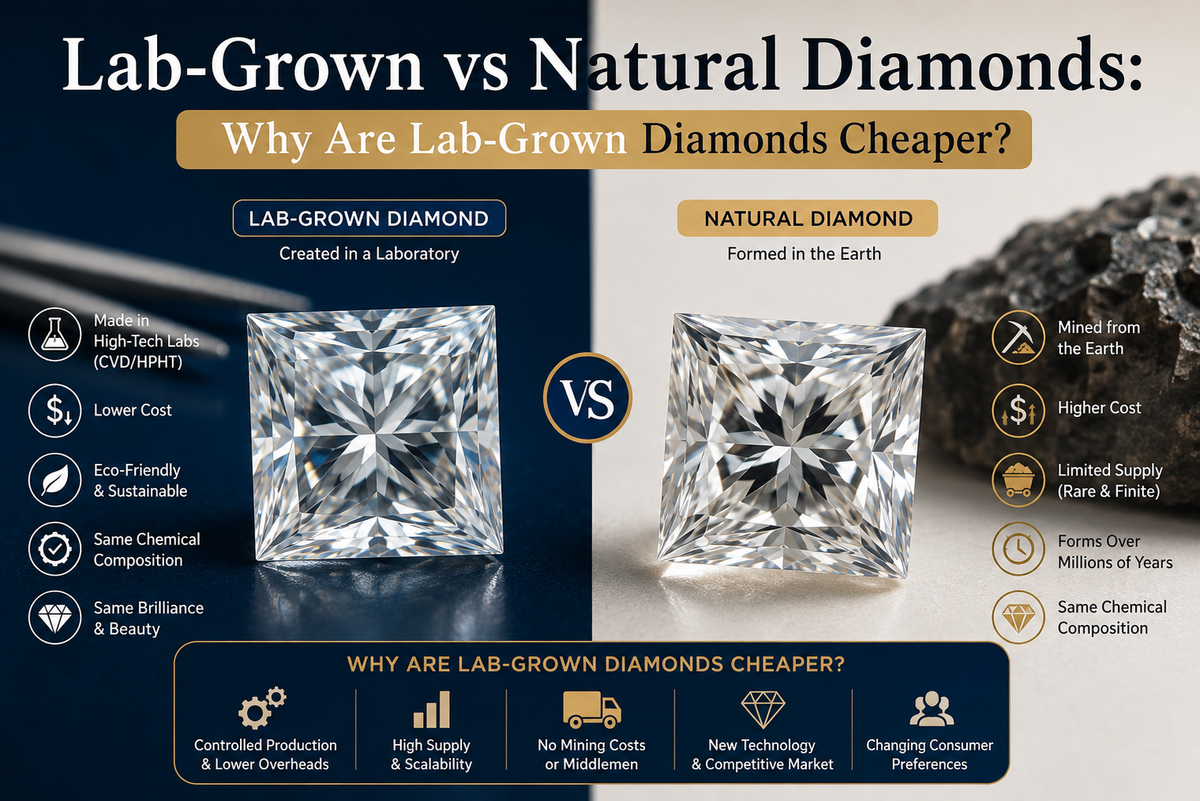
Lab-Grown vs Natural Diamonds: Why Are Lab-Grown Diamonds Cheaper?
Diamonds have traditionally been associated with rarity, luxury, and timeless beauty. However, lab-grown diamonds have transformed the modern diamond market by offering consumers another way to purchase a real diamond at a significantly lower price. One of the most common questions shoppers ask is: Why Are Lab-Grown Diamonds Cheaper than natural diamonds?
The answer isn't simply that lab-grown diamonds are "fake" or lower quality. Lab-grown diamonds are real diamonds with essentially the same chemical composition and crystal structure as natural diamonds. The major difference is where and how they are formed. In this guide, we'll explore the Lab-Grown vs Natural Diamonds price difference and explain 10 important differences between the two.
Key Takeaways
-
Why Are Lab-Grown Diamonds Cheaper? Primarily because they don't require the same mining, exploration, and rarity premium associated with natural diamonds.
-
Lab-grown diamonds have essentially the same chemical composition and crystal structure as natural diamonds.
-
Natural diamonds form naturally underground over geological timescales.
-
Lab-grown diamonds are created using advanced technologies such as CVD and HPHT.
-
The Lab-grown vs natural diamond price comparison can vary depending on carat, cut, color, clarity, certification, and market conditions.
-
Lab-grown diamonds can provide more diamond size or quality for a given budget.
-
Natural diamonds retain a stronger association with geological rarity and traditional luxury.
-
Neither option is automatically "better"; the right choice depends on your priorities and budget.
What Is the Difference Between Lab-Grown and Natural Diamonds?
The main difference between natural diamonds and lab-grown diamonds is where they come from. Natural diamonds come from inside the Earth. They form in the Earth's mantle, where it's really hot and there is a lot of pressure. This happens over a long time. Natural diamonds are brought up to the Earth's surface by things that happen in the Earth. Lab-grown diamonds are made by people using machines. These machines make conditions that're similar to how natural diamonds are made. Natural diamonds and lab-grown diamonds are different because of how they're made and where they come from.
There are two primary production methods:
-
Chemical Vapor Deposition (CVD)
-
High Pressure High Temperature (HPHT)
Both methods can produce diamonds with the same basic carbon crystal structure found in natural diamonds.
Also Read: What Is a Bezel Set Engagement Ring? A Complete Buying Guide
Why Are Lab-Grown Diamonds Cheaper than Natural Diamond?
1. Origin: Laboratory vs Earth
The main difference between Lab-Grown Diamonds and Natural Diamonds is where they come from. Natural Diamonds are made inside the Earth. Lab-Grown Diamonds are made in places with really good machines. Just because Lab-Grown Diamonds are made in a different way does not mean they are fake. They are still Lab-Grown Diamonds; it is just that they are made differently. Lab-Grown Diamonds are diamonds; they are just made in a different way than Natural Diamonds.
2. Formation Time
Natural diamonds form over a long period of time deep under the Earth's surface. Lab-grown diamonds are made in a controlled environment. Take much less time to produce. This difference in how long it takes to form is one reason why lab-grown diamonds can be made based on what the market needs instead of depending only on diamonds that are found naturally.
3. Production Process
Natural diamonds require mining and extensive geological exploration to locate diamond deposits. Lab-grown diamonds are manufactured using controlled processes.
CVD
CVD stands for Chemical Vapor Deposition. A carbon-containing gas is introduced into a chamber where conditions allow carbon atoms to deposit and form diamond crystal layers.
HPHT
HPHT stands for High Pressure High Temperature. This method recreates high-pressure and high-temperature conditions used to form diamond crystals.
Both processes can create gem-quality diamonds.
4. Price
This is the most important difference for many shoppers.
Why Are Lab-Grown Diamonds Cheaper?
A major reason is that natural diamonds carry costs associated with:
-
Geological exploration
-
Mining operations
-
Extraction
-
Processing
-
Transportation
-
Sorting
-
Limited natural supply
-
Traditional market structure
-
Rarity and scarcity
Lab-grown diamonds don't require traditional diamond mining. Their production takes place in controlled facilities, allowing manufacturers to increase production according to demand. As a result, lab-grown diamond prices can be substantially lower than the price of a comparable natural diamond. However, the exact price difference varies depending on the diamond's specifications and market conditions.
5. Rarity and Natural Supply
Natural diamonds are limited because there are no places in the world where they can be mined in a way that makes sense economically. This limited availability plays a role in how they are seen in the market and how much they cost. Lab-grown diamonds can be made over and over again using methods that are already in place.
This difference in how much's available is a key point when comparing the prices of Natural Diamonds and Lab-Grown Diamonds. Natural Diamonds usually have a higher price because they are rare. Lab-Grown Diamonds are more related to how much it costs to make them and what people want to buy.
6. Diamond Appearance
For the average consumer, it can be extremely difficult to distinguish a high-quality lab-grown diamond from a natural diamond simply by looking at it.
Both can display:
-
Brilliance
-
Fire
-
Sparkle
-
Transparency
-
Exceptional hardness
The way a diamond looks depends a lot on how it's cut, what color it is, how clear it is, and how much it weighs, not just if it was made in a lab or came from the earth. That's why experts use tests to find out where a diamond came from.
7. Chemical and Physical Properties
One of the most important points in the Lab-Grown vs Natural Diamonds discussion is that lab-grown diamonds are not the same as diamond simulants. A diamond simulant, such as cubic zirconia or some forms of moissanite, is a different material that imitates the appearance of diamond.
Lab-grown diamonds, by contrast, are diamond.
They have essentially the same:
-
Carbon crystal structure
-
Hardness
-
Optical characteristics
-
Thermal conductivity
as natural diamonds, although trace elements and growth characteristics can differ.
8. Resale and Long-Term Value
When you are buying diamonds, you have to think about the value. Natural diamonds are really valuable because they are rare and people have always wanted them. This means they can be sold for a price. Lab-grown diamonds are different. They are a thing, and their prices can change a lot because more and more of them are being made and the technology to make them is getting better.
So if you want to be able to sell your diamond someday, you should look into the specific diamond you are thinking about and see what is going on in the market right now. Do not just assume that you will be able to get an amount of money back for it. Natural diamonds and lab-grown diamonds are different. You need to research them to know what to expect.
9. Environmental and Mining Considerations
Natural diamond production involves mining, which can have environmental and land-use impacts. Mining operations may involve significant energy, water, transportation, and land requirements. Lab-grown diamonds avoid traditional diamond mining, but they still require energy and industrial infrastructure. Therefore, it is better to view sustainability as a broader comparison rather than assuming that every lab-grown diamond has the same environmental footprint. Consumers interested in this factor should consider the producer's energy sources, manufacturing practices, certifications, and transparency.
10. Buying Options and Personal Preference
The final difference is the type of buying decision each option represents.
A natural diamond may appeal to someone who values:
-
Geological rarity
-
Natural origin
-
Traditional diamond heritage
-
Long-established luxury appeal
A lab-grown diamond may appeal to someone who values:
-
Lower purchase cost
-
Larger diamond size for a budget
-
Modern technology
-
Avoiding traditional diamond mining
-
Contemporary jewelry choices
Ultimately, Lab-Grown Diamonds vs Natural Diamonds is not simply a question of which one is better. It is about which characteristics matter most to you.
Lab-Grown vs Natural Diamond Price Comparison
People want to know the difference in price between Lab-grown diamonds and natural diamonds. They want to see what they can get for their money. For instance, someone might be able to buy a Lab-grown diamond or one that is better quality than a natural diamond for the same amount of money they were planning to spend. This helps them decide what to buy with their budget. Lab-grown diamonds can be an option because they can offer more for the same price as natural diamonds. However, there isn't one fixed answer to how much cheaper lab-grown diamonds are than natural diamonds.
The difference can change considerably based on:
-
Carat weight
-
Cut
-
Color
-
Clarity
-
Shape
-
Certification
-
Brand
-
Market demand
-
Production costs
Therefore, shoppers should compare diamonds with similar specifications rather than comparing only their carat weights.
Are Lab-Grown Diamonds Real Diamonds?
Yes. Lab-grown diamonds are real diamonds. They should not be confused with diamond simulants. A lab-grown diamond is made using machines and technology, not from the earth like regular diamonds. Lab-grown diamonds still have the same look and feel as real diamonds. That is why people are starting to like lab-grown diamonds more for things like engagement rings, wedding jewelry, earrings, tennis bracelets, and other kinds of diamond jewelry. Lab-grown diamonds are a choice because they are still diamonds, just made differently.
Why Do Lab-Grown Diamonds Cost Less Than Natural Diamonds?
The answer comes down to several interconnected factors.
Why do lab-grown diamonds cost less than natural diamonds?
The biggest factors include:
-
Different production methods
-
No traditional mining requirement
-
Greater ability to scale production
-
Less geological scarcity
-
Different supply dynamics
-
Lower scarcity premium
-
Advances in diamond-growing technology
-
Growing competition among producers
-
Changing consumer preferences
-
A newer and evolving market
As production technology improves, manufacturers can produce diamonds more efficiently. This contributes to the price gap between lab-grown and natural diamonds.
Which Should You Choose: Lab-Grown or Natural?
There is no universal answer.
Choose a Lab-Grown Diamond If You Want:
-
More diamond for your budget
-
A modern alternative to mined diamonds
-
A real diamond at a lower purchase price
-
Contemporary jewelry choices
-
A diamond without traditional mining
Choose a Natural Diamond If You Prefer:
-
Geological rarity
-
Natural origin
-
Traditional diamond heritage
-
Established luxury positioning
-
The symbolism of a naturally formed gemstone
For an engagement ring, both can create a beautiful and meaningful piece of jewelry.
Final Verdict: Lab-Grown vs Natural Diamonds
The biggest difference in the Lab-Grown vs Natural Diamonds comparison is not whether one is a real diamond and the other isn't. Both are diamonds; the key distinction is origin, production, supply, rarity, and market economics. Why Are Lab-Grown Diamonds Cheaper? Because they can be produced in controlled environments without the same geological exploration, mining, and natural scarcity constraints associated with natural diamonds. For shoppers focused on maximizing size and quality within a specific budget, lab-grown diamonds can be an attractive option. For those who place a premium on natural origin and geological rarity, natural diamonds remain a compelling choice.
The best diamond is ultimately the one that matches your budget, priorities, style, and personal values.
Frequently Asked Questions
1. Why Are Lab-Grown Diamonds Cheaper Than Natural Diamonds?
Lab-grown diamonds are generally cheaper because they can be produced in controlled facilities without the same mining, geological exploration, and natural scarcity factors associated with natural diamonds.
2. Are Lab-Grown Diamonds Real Diamonds?
Yes. Lab-grown diamonds are real diamonds. They have essentially the same chemical composition and crystal structure as natural diamonds, although their growth characteristics and trace elements can differ.
3. How Much Cheaper Are Lab-Grown Diamonds Than Natural Diamonds?
There is no single fixed percentage. The difference depends on carat weight, cut, color, clarity, shape, certification, brand, supply, and market conditions.
4. Are Lab-Grown Diamonds Better Than Natural Diamonds?
Neither is universally better. Lab-grown diamonds may be better suited to shoppers prioritizing price and size, while natural diamonds may appeal more to those prioritizing natural rarity and traditional diamond heritage.
5. Do Lab-Grown Diamonds Have the Same Quality as Natural Diamonds?
A high-quality lab-grown diamond can have comparable physical and optical properties to a natural diamond. As with natural diamonds, quality depends on characteristics such as cut, color, clarity, and carat weight.

Written by Shikhar Jain