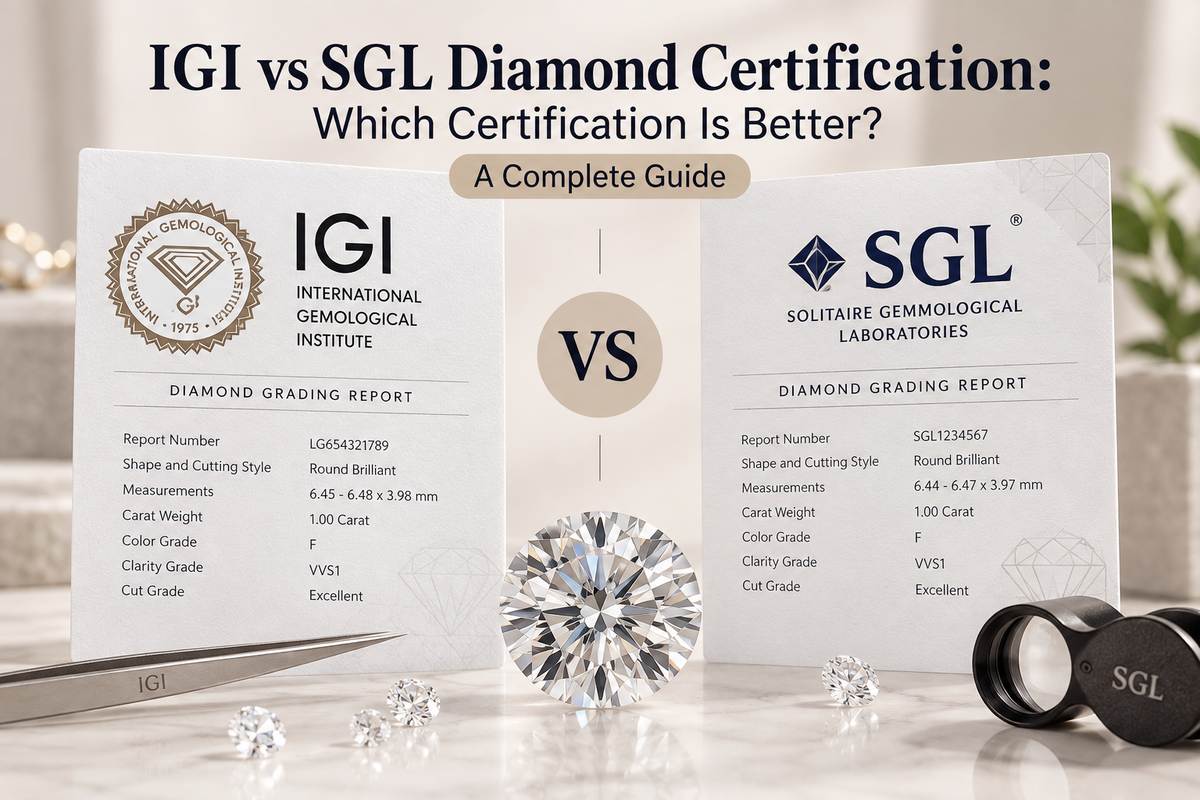
IGI vs SGL Diamond Certification: Which Certification Is Better? A Complete Guide
IGI vs SGL: Buying a diamond is a choice whether you are picking an engagement ring, diamond earrings, a pendant, or another piece of fine jewelry. Along with the diamond's look, people who are buying should know what they are getting. This is when a diamond certificate or a diamond grading report is useful.
When comparing IGI vs SGL diamond certification, many buyers want to know which certificate is more reliable, what information each report provides, and whether an IGI-certified diamond or SGL-certified diamond is the better choice.
The quick answer is that the best choice depends on the diamond, the kind of report your money is for, and how much you care about approval and third-party checking. A certificate should never be the thing you look at. You should also check the diamond's quality, like its cut, color, clarity, weight, measurements, and how it looks overall.
This complete guide explains the difference between IGI and SGL, how diamond reports work, and what you should check before buying a certified diamond.
Key Takeaways
-
IGI vs SGL should be compared based on the actual laboratory, report quality, and verification options.
-
IGI certification offers broad recognition and official online verification of reports.
-
An IGI diamond report documents important quality characteristics, including the 4Cs and, where applicable, natural or laboratory-grown origin.
-
An SGL-certified diamond should always be checked against the exact laboratory that issued the report.
-
Always learn how to check a diamond certificate before making a purchase.
-
IGI certificate verification can be completed through IGI's official report lookup system.
-
Never rely on a certificate alone—compare the actual diamond's quality, price, and seller transparency.
What Is Diamond Certification and Why Does It Matter?
A diamond certificate, which is also known as a diamond grading report, is an independent document that describes the characteristics of a diamond. This document helps buyers understand the diamond by providing information instead of relying only on a seller's description.
The most important characteristics are commonly known as the 4Cs:
-
Cut – How well the diamond has been cut and how it interacts with light.
-
Colour – The degree of colour present in a white diamond.
-
Clarity – Internal inclusions and external characteristics.
-
Carat Weight – The diamond's weight.
A diamond grading report may also include measurements, proportions, fluorescence, polish, symmetry, identifying characteristics, and information about whether the diamond is natural or laboratory-grown.
An independent certificate can help you compare diamonds easily. Buyers should remember that a grading report is an expert assessment of a diamond's characteristics, not a guarantee of the diamond's future price or resale value.
Also Read: IGI vs GIA Lab Grown Diamonds: Which Certification Is Better in 2026?
What Is IGI Certification?
IGI, or the International Gemological Institute, is an internationally recognized organization providing grading and identification services for diamonds, gemstones, and jewellery.
So, what is IGI certification? An IGI diamond report provides documented information about a diamond's characteristics. IGI reports may identify whether a diamond is natural or laboratory-grown and document important quality characteristics.
IGI looks at the 4Cs—cut, colour, clarity, and carat weight—plus other important traits that depend on the report format. IGI also offers a way to verify reports, allowing buyers to check the report details by using the certificate or report number.

IGI Certified Diamond Meaning
The term IGI certified diamond meaning generally refers to a diamond that has been examined and issued an IGI grading report. The report provides documented information about the diamond's identity and quality characteristics. An IGI certified diamond can be useful for buyers because the report gives a point of reference when comparing diamonds from different sellers. IGI also grades both laboratory‑grown diamonds, making IGI diamond certification especially relevant to buyers shopping across both categories. IGI says that its diamond reports identify whether a diamond is natural or laboratory‑grown and document the diamond's 4C characteristics.
What Is SGL Certification?
Many buyers also ask, what is SGL certification? SGL diamond certification means a diamond grading or certification report that is given by a group that uses the SGL name. This is often linked in the jewelry market with Solitaire Gemmological Laboratories. Before buying, however, people should look closely at the laboratory name that is written on the certificate because short forms and similar names can be confusing.
An SGL diamond certificate may provide information about the diamond's characteristics, depending on the specific report and laboratory issuing it. Buyers should carefully review:
-
Diamond type and identification
-
Carat weight
-
Colour grade
-
Clarity grade
-
Cut or shape information
-
Measurements
-
Report number
-
Security features
-
Online or digital verification options
The usefulness of an SGL diamond report depends not only on the laboratory name but also on the specific report, the grading methodology, and whether the certificate can be independently verified.
For this reason, buyers should always verify the report directly through the issuing laboratory rather than relying only on a printed certificate supplied by a seller.

IGI vs SGL: The Main Difference
The biggest question for buyers is the difference between IGI and SGL.
Although both names may be used in connection with diamond certification, they may differ in areas such as international recognition, report formats, laboratory networks, market presence, and verification systems.
1. International Recognition
IGI has a significant international presence and provides diamond, gemstone, and jewellery grading services across multiple markets. Buyers of both natural and laboratory-grown diamonds commonly encounter its reports.
IGI states that it operates laboratories and educational institutions internationally and provides grading reports intended to help consumers and professionals make informed decisions.
For buyers who prioritize broad international familiarity, an IGI report may therefore be easier to recognize when purchasing diamonds across different markets.
2. Diamond Report Information
Both an IGI diamond report and an SGL diamond report should be reviewed based on the actual information provided.
A good diamond certificate should clearly identify important characteristics such as:
-
Carat weight
-
Colour
-
Clarity
-
Cut or shape
-
Measurements
-
Proportions where applicable
-
Natural or laboratory-grown origin where applicable
-
Unique report number
-
Security or verification information
Do not choose a diamond simply because one certificate appears more detailed. Instead, compare the actual diamond and ensure that the report information matches the stone you are buying.
3. Online Certificate Verification
One of the most important considerations when comparing IGI vs SGL certification is report verification.
IGI provides an official online system where buyers can enter a report number to check report information. This is useful when confirming that the certificate corresponds to an existing report in the laboratory's records.
For an SGL-certified diamond, buyers should use the official verification method provided by the exact laboratory named on the report. Do not assume that every organization using the initials "SGL" uses the same verification database.
4. Natural and Lab-Grown Diamond Reports
The certification requirements may also depend on whether you are purchasing a natural or laboratory-grown diamond.
IGI provides reports for both categories and identifies the origin in its diamond reporting. This makes IGI a familiar option for many buyers comparing lab-grown diamonds.
If you are purchasing an SGL-certified diamond, carefully check whether the report clearly identifies the diamond's origin and describes its grading characteristics.
IGI vs SGL Diamond Certification: Comparison Table
|
Feature |
IGI |
SGL |
|
Full name |
International Gemological Institute |
Check the exact laboratory named on the report |
|
Diamond report |
Available for diamond grading |
Depends on the issuing laboratory and report format |
|
Natural diamonds |
Reports available |
Check the specific report |
|
Lab-grown diamonds |
Reports available |
Check the specific report |
|
4Cs information |
Included according to report type |
Review the individual report |
|
Online verification |
Official report verification available |
Verify through the exact issuing laboratory |
|
International familiarity |
Broad international presence |
May vary by laboratory and market |
|
Best for |
Buyers seeking a widely recognized grading report |
Buyers who verify the exact laboratory and report details |

IGI or SGL: Which Is Better?
So, IGI or SGL—which is better?
There is no single answer for every buyer. However, if you are choosing primarily based on broad international recognition and the availability of an established online report verification system, an IGI-certified diamond may be the more straightforward choice for many consumers.
IGI reports are made to record details about a diamond, like the four Cs. Whether the diamond is natural or made in a lab. That being said, a diamond that has an SGL certificate should not always be seen as an option. The person buying should look at the lab that did the certification, check the report, look at the diamond's real features, and think about the seller's trustworthiness.
The main idea is this: A certificate only helps if you know who gave it, what the report checks, and if the details can be checked on your own.
Is IGI Better Than SGL?
The question “Is IGI better than SGL?” is often asked by diamond buyers, especially in India.
For shoppers, IGI might seem like a better choice because it has a stronger international name and a proven track record in report verification. Just because IGI is considered better doesn't mean every diamond certified by IGI is better than every diamond certified by SGL. It's not that simple. Each diamond should be judged on its merits, not just the brand of the lab that certified it.
For example, a diamond that has an IGI certificate and has a cut might not be a better buy than another diamond just because it has the certificate. You should compare:
-
The actual diamond quality
-
The complete grading report
-
The diamond's visual appearance
-
The laboratory's verification system
-
The price
-
The seller's reputation
-
Return and exchange policies
Certification is one important part of diamond buying, but it should be considered alongside the actual product.
How to Check a Diamond Certificate Before Buying
Knowing how to check diamond certificate information can help you avoid mistakes.
Follow these steps:
Check the Report Number
Every report should have a unique identification number. Compare this number carefully with the information supplied by the seller.
Verify the Certificate Online
Use the official website of the issuing laboratory whenever possible.
For IGI certificate verification, enter the report number into IGI's official report verification system and compare the digital information with the physical or digital certificate provided with the diamond.
Compare the Diamond Details
Make sure the following information matches:
-
Carat weight
-
Shape
-
Measurements
-
Colour grade
-
Clarity grade
-
Cut grade, where applicable
-
Report number
-
Laser inscription, if present
Check for Laser Inscription
Some diamonds may have the report number laser-inscribed on the girdle. If available, this can help connect the physical diamond with its grading report. IGI notes that laser inscription can be used to identify a diamond and link it with its gemological details.
How to Verify an IGI Certificate
If you are wondering how to verify an IGI certificate, follow these steps:
-
Visit IGI's official report verification service.
-
Enter the report number exactly as shown on the certificate.
-
Review the information returned by the official database.
-
Compare the online details with the certificate.
-
Compare those details with the actual diamond.
-
Contact the laboratory or seller if there is a discrepancy.
IGI's official verification service is available through its report lookup system.

How to Verify SGL Certificate
To understand how to verify an SGL certificate, first identify the exact laboratory name printed on the certificate.
Then:
-
Visit the official website of that specific laboratory.
-
Locate its certificate or report verification tool.
-
Enter the report number and any additional information requested.
-
Compare the verified data with the certificate.
-
Match the report details with the physical diamond.
If you cannot find an official verification method, contact the issuing laboratory directly before completing your purchase.

Which Diamond Certification Should You Choose?
When choosing between IGI vs SGL diamond certification, consider your priorities.
Choose an IGI diamond report if you prefer:
-
Broad international recognition
-
A well-established diamond grading organization
-
Official online report verification
-
Reports for natural and laboratory-grown diamonds
-
Clear documentation of important diamond characteristics
Consider an SGL certified diamond when:
-
You understand exactly which laboratory issued the report
-
The certificate can be independently verified
-
The report clearly documents the diamond's important characteristics
-
You have compared the diamond with other certified options
-
The seller is transparent about certification and return policies
Final Verdict: IGI vs SGL Diamond Certification
When comparing IGI vs SGL diamond certification, the best choice is not determined by the certificate name alone. IGI may be the option for many buyers because of IGI's broad international recognition, IGI's established grading services, and IGI's official report verification tools. IGI reports document diamond characteristics and can identify whether a diamond is natural or laboratory-grown. However, an SGL diamond certificate can still be useful. SGL diamond certificate is useful only if it comes from an identified laboratory, gives meaningful grading information, and can be independently verified. Ultimately, the smartest approach is to verify the certificate, compare the actual diamond, understand the 4Cs, and purchase from a transparent and reputable seller. A diamond certificate provides valuable information—but an informed buyer should always look beyond the certificate and evaluate the complete diamond purchase. Before buying a diamond, always verify its grading report, understand the diamond's 4Cs, and compare its quality and price carefully. Whether you choose an IGI-certified diamond or an SGL-certified diamond, checking the authenticity and details of the certificate can help you make a more confident and informed purchase.
Frequently Asked Questions About IGI vs SGL
1. Is IGI better than SGL for diamond certification?
For buyers who value broad international recognition and established online report verification, IGI may be the preferred option. However, the actual diamond quality, report details, and verification process should always be considered before making a purchase.
2. What is an IGI certified diamond?
An IGI-certified diamond is a diamond that has been examined and issued an IGI grading report. The report documents important characteristics such as the 4Cs and may identify whether the diamond is natural or laboratory-grown.
3. How can I verify an IGI certificate?
You can use IGI's official online report verification system. Enter the report number and compare the verified information with the certificate and the physical diamond.
4. How do I verify an SGL diamond certificate?
First, identify the exact laboratory that issued the SGL certificate. Then use that laboratory's official verification service or contact the laboratory directly to confirm the report details.
5. Does diamond certification guarantee a diamond's value?
No. A diamond grading report documents characteristics and quality factors, but it is not a guarantee of future resale value or an appraisal. Diamond prices can vary based on market conditions, demand, cut quality, brand, and other factors. IGI also states that its reports are expert opinions and are not guarantees, appraisals, or warranties.

Written by Shikhar Jain