Zirconia vs Lab Grown Diamond vs Natural Diamond: Complete Comparison Guide
When you are shopping for jewelry, it is easy to get confused between zirconia, lab-grown diamonds, and natural diamonds. At a glance, zirconia, lab-grown diamonds, and natural diamonds can look almost the same. These three materials are actually very different. They differ when you look at how they're made, how long they last, how much they sparkle, how much they cost, their total value, and where they come from. Understanding the difference between zirconia vs lab grown diamond vs natural diamond can help you choose the right option for an engagement ring, wedding ring, earrings, necklace, or everyday jewelry. In this guide, we will compare cubic zirconia vs lab grown diamond, cubic zirconia vs natural diamond, and lab grown diamond vs natural diamond so you can make a more informed jewelry decision.
Key Takeaways: Zirconia vs Lab Grown Diamond vs Natural Diamond
-
Cubic zirconia (CZ) is not a diamond; it is a diamond simulant made from zirconium dioxide.
-
Lab grown diamonds are real diamonds with essentially the same chemical composition and crystal structure as natural diamonds.
-
Natural diamonds are formed naturally inside the Earth over geological periods and are recovered through mining.
-
Diamond is harder than cubic zirconia. Diamond ranks 10 on the Mohs hardness scale, while CZ is typically around 8–8.5.
-
Lab-grown and natural diamonds offer similar fundamental durability because both are diamond.
-
Cubic zirconia is generally the most affordable option, making it popular for fashion and budget-friendly jewelry.
-
Lab-grown diamonds are generally less expensive than comparable natural diamonds, while still being genuine diamonds.
-
CZ can look similar to diamond, but its optical properties, durability, and long-term performance are different.
-
For everyday jewelry and engagement rings, lab-grown or natural diamonds are generally more suitable than CZ.
-
The best choice depends on budget, durability, appearance, diamond origin, and personal preference.
What Is Zirconia?
When people talk about "zirconia" in jewelry, they are usually talking about zirconia (CZ). Cubic zirconia is a gemstone that people make in a lab using zirconium dioxide. People make cubic zirconia to look like a real diamond, but cubic zirconia is not actually a diamond. Is cubic zirconia a real diamond? No. Cubic zirconia is a diamond simulant, meaning it resembles a diamond visually but has a different chemical composition and physical properties. CZ is popular because it offers attractive sparkle at a much lower price than diamonds. It is commonly used in fashion jewelry and affordable alternatives to diamond jewelry.

Also Read: Bezel vs Prong Setting: Which Is Better for Your Jewelry in 2026?
What Is a Lab Grown Diamond?
A lab-grown diamond is a diamond created with advanced technology in a controlled laboratory setting. It has the chemical composition, crystal structure, and physical properties as a natural diamond. Most lab-grown diamonds are made using CVD (Chemical Vapor Deposition) or HPHT (High Pressure High Temperature) methods. Unlike zirconia, a lab-grown diamond is not simply a look‑alike; it is a genuine diamond, only its origin differs from a natural diamond.

What Is a Natural Diamond?
A natural diamond forms deep within the Earth's mantle over extremely long geological periods under intense heat and pressure. It is then mined, cut, polished, graded, and used in jewelry. Natural diamonds are valued for their natural origin, rarity, traditional appeal, and long-established position in the jewelry market.

Zirconia vs Lab Grown Diamond
The biggest difference between zirconia and a lab-grown diamond is that zirconia is a look-alike while a lab-grown diamond is a real diamond. Cubic zirconia does not have the chemical makeup of a diamond. Because of this, cubic zirconia is usually not as hard or as tough as a diamond. A lab-grown diamond has all the basic diamond properties that a natural diamond has. If you want the appearance of a diamond at the lowest possible cost, CZ can be attractive. If you want a genuine diamond with long-term durability, a lab-grown diamond is the stronger choice.
Cubic Zirconia vs Natural Diamond
The comparison between zirconia and natural diamond is similar. However, there are differences in appearance, durability, rarity, and price. Cubic zirconia is made as a diamond alternative. Natural diamonds are naturally formed gemstones with hardness and durability.
CZ vs Natural Diamond Hardness
Diamond is the hardest naturally occurring mineral and ranks 10 on the Mohs hardness scale. Cubic zirconia is softer, typically around 8–8.5 on the Mohs scale. This means a diamond is usually much harder to scratch than CZ. If you want jewelry that you will wear every day like an engagement ring or a wedding ring, then this difference in hardness and durability matters a lot.
Does Cubic Zirconia Sparkle Like a Diamond?
Yes, cubic zirconia can sparkle a lot. Can look almost the same as a diamond when seen from far away. However, the optical properties of zirconia are not the same as those of a diamond. A trained eye can often tell zirconia apart from a diamond by looking at the brilliance, dispersion, facet reflections, and overall look. Cubic zirconia may also get scratches. Lose some of its visual charm over time, especially when it is worn often.
Lab Grown Diamond vs Natural Diamond
The comparison between lab grown diamond vs natural diamond is different from the CZ comparison because both are actual diamonds. The main difference is their origin. A natural diamond develops naturally inside the Earth, while a lab grown diamond is created using technological processes in a laboratory. Both can have the same basic crystal structure and chemical composition, and both can be graded for characteristics such as cut, color, clarity, and carat weight.
Lab Grown Diamond vs Natural Diamond Price
One difference you will notice is the price. Lab-grown diamonds are usually much cheaper than diamonds of the same size. This is because lab-grown diamonds do not need to be mined and are made in a lab. Natural diamonds often cost a lot of money because natural diamonds are rare and come from the earth. People also want diamonds because there is a big market for natural diamonds. Still, diamond prices change a lot. You have to look at the carat, cut, color, clarity, certification, shape, and market conditions to determine diamond prices.
Therefore, price alone should not be used to determine diamond quality.
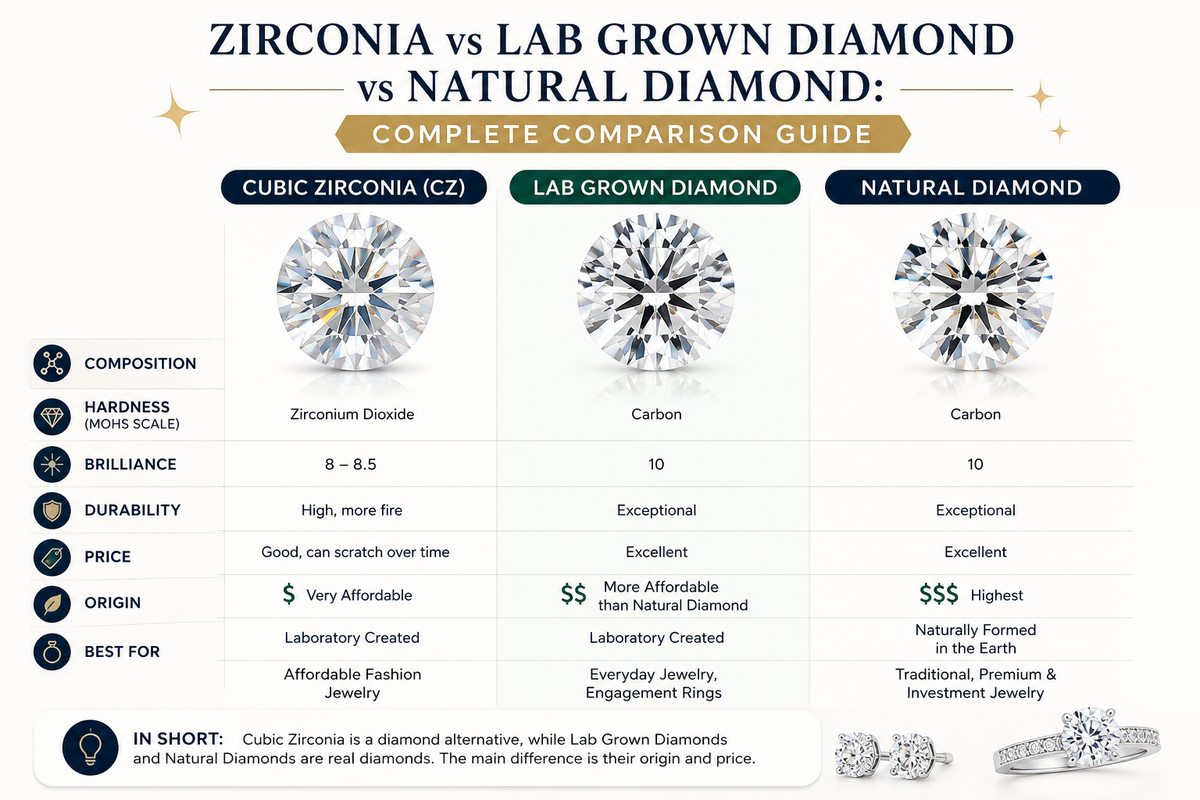
Key Differences Between Zirconia, Lab Grown Diamond, and Natural Diamond
|
Feature |
Cubic Zirconia (CZ) |
Lab Grown Diamond |
Natural Diamond |
|
What is it? |
Diamond simulant |
Real diamond |
Real diamond |
|
Composition |
Zirconium dioxide |
Carbon |
Carbon |
|
Origin |
Laboratory-created |
Laboratory-created |
Naturally formed inside Earth |
|
Is it a real diamond? |
No |
Yes |
Yes |
|
Mohs Hardness |
Approx. 8–8.5 |
10 |
10 |
|
Brilliance |
High, but different from diamond |
Genuine diamond brilliance |
Genuine diamond brilliance |
|
Durability |
Good, but lower than diamond |
Excellent |
Excellent |
|
Price |
Lowest |
Generally lower than natural diamond |
Generally highest |
|
Rarity |
Not rare |
Manufactured |
Naturally rare |
|
Everyday Wear |
Suitable, but may scratch over time |
Excellent |
Excellent |
|
Best For |
Affordable fashion jewelry |
Affordable genuine diamond jewelry |
Traditional and natural diamond jewelry |
Zirconia vs Lab Grown Diamond vs Natural Diamond: Price Comparison
When comparing zirconia vs lab grown diamond price, CZ is usually the most affordable option.
A general price hierarchy is:
Cubic Zirconia → Lab Grown Diamond → Natural Diamond
This does not mean every lab-grown diamond will cost more than every natural diamond. Prices depend on the specifications of each stone. Cubic zirconia is inexpensive because it is a manufactured diamond simulant. Lab-grown diamonds require sophisticated production technology and are genuine diamonds. Natural diamonds involve exploration, mining, processing, cutting, grading, and distribution.
Zirconia vs Diamond Durability
Durability is one of the most important factors when choosing jewelry. A diamond has a 10 Mohs hardness rating. This means a diamond is very hard to scratch. This is one reason why people love diamonds for engagement rings and jewelry they wear every day. Cubic zirconia is much softer. Because cubic zirconia is softer, cubic zirconia can get scratched up easily over time. If you want to pick a stone for jewelry that you plan to wear every day, a diamond—whether it is a natural diamond or a lab-grown diamond—is usually a better choice than cubic zirconia because a diamond lasts longer.
Which Is Better: Zirconia or Lab Grown Diamond?
The answer depends on your budget and priorities.
Choose cubic zirconia if:
-
You want a very affordable diamond alternative.
-
You are buying fashion jewelry.
-
You want the look of a diamond without the cost.
-
The jewelry will not receive heavy everyday wear.
Choose a lab-grown diamond if:
-
You want a genuine diamond.
-
You want excellent durability.
-
You prefer a lower price than a comparable natural diamond.
-
You want a stone suitable for everyday jewelry.
-
You value diamond characteristics such as cut, clarity, color, and carat.
For an engagement ring or long-term everyday jewelry, a lab-grown diamond is generally the more suitable option than CZ.
Which Is Better: Lab Grown or Natural Diamond?
You cannot really say that one type of diamond is better than the other. The best choice really just depends on what you care about most. A lab-grown diamond might be the pick for you if you want a real diamond that costs less money. Choosing a lab-grown diamond can help you get a better diamond without spending too much. A natural diamond might be a choice if you love the idea of a natural origin. Some people prefer a diamond because they value the rarity and the long history behind mined diamonds. Both lab-grown diamonds and natural diamonds will make jewelry that looks beautiful and lasts a long time.
How to Choose Between CZ, Lab Grown Diamond, and Natural Diamond
Consider these factors before making your decision:
1. Budget
If your primary concern is affordability, CZ is the least expensive option. Lab-grown diamonds provide a way to purchase a genuine diamond while typically spending less than you would on a comparable natural diamond.
2. Durability
For everyday jewelry, diamond offers excellent scratch resistance. Both lab-grown and natural diamonds have the same fundamental hardness.
3. Appearance
All three can look beautiful, but they have different optical characteristics. CZ can imitate diamond effectively, while lab-grown and natural diamonds possess genuine diamond optical properties.
4. Long-Term Wear
If you plan to wear the jewelry every day for many years, a lab-grown or natural diamond is generally a better choice than CZ.
5. Personal Preference
Some shoppers prefer the affordability of CZ, others appreciate the technology behind lab-grown diamonds, while some specifically want a naturally formed diamond.
Final Verdict: Zirconia vs Lab Grown Diamond vs Natural Diamond
The choice between zirconia vs lab grown diamond vs natural diamond ultimately comes down to your budget, lifestyle, and personal preferences. Cubic zirconia is an affordable diamond alternative. Works well for fashion jewelry or occasional wear. Lab-grown diamonds are diamonds with properties comparable to natural diamonds and are generally more affordable than comparable mined diamonds. Natural diamonds offer a formed origin, rarity, and traditional appeal that many jewelry buyers continue to value. If durability and genuine diamond characteristics are your priorities, both lab-grown and natural diamonds are choices. If affordability is the consideration, cubic zirconia can provide a diamond-like appearance at a much lower cost.
Frequently Asked Questions
1. Is zirconia the same as a lab-grown diamond?
No. Cubic zirconia and lab-grown diamonds are different materials. Cubic zirconia is a diamond simulant made primarily from zirconium dioxide, while a lab-grown diamond is a genuine diamond created in a laboratory.
2. Is cubic zirconia a real diamond?
No. Cubic zirconia is not a real diamond. It is a synthetic gemstone designed to resemble diamond in appearance. A lab-grown diamond, on the other hand, is a genuine diamond.
3. What is the difference between zirconia and natural diamond?
Cubic zirconia is laboratory-created zirconium dioxide, while a natural diamond is carbon crystallized naturally deep inside the Earth. Diamond is also significantly harder, making it more suitable for long-term everyday wear.
4. Is lab-grown diamond better than zirconia?
For everyday jewelry, a lab-grown diamond is generally the better option if you want a genuine diamond with high durability and diamond optical properties. CZ is better suited to buyers primarily focused on affordability.
5. Is a natural diamond better than a lab-grown diamond?
Neither is universally better. Natural diamonds offer natural origin and traditional rarity, while lab-grown diamonds offer genuine diamond properties at generally lower prices. The right choice depends on your budget and preferences.

Written by Shikhar Jain